Entry Tactics
Buying in Bases
The signs I look for when a base is starting to come up the right side.
 Nick SchmidtPublishedUpdated
I used to give breakouts most of my attention, but now I care just as much about the base that came before them.
That is why I study the stretch after a stock has already made a big move and then spends weeks or months going nowhere. In my review, some bases have characteristics that make me more willing to act.
The bases I prefer usually start with a stock that has already proved itself to me. The trend was already up, the stock ran hard, and now it is digesting. This is different from a character change, where I am looking for a stock to flip from a downtrend into a new uptrend. Buying in a base gives me time to get involved before the next move if it comes.
Reading the base
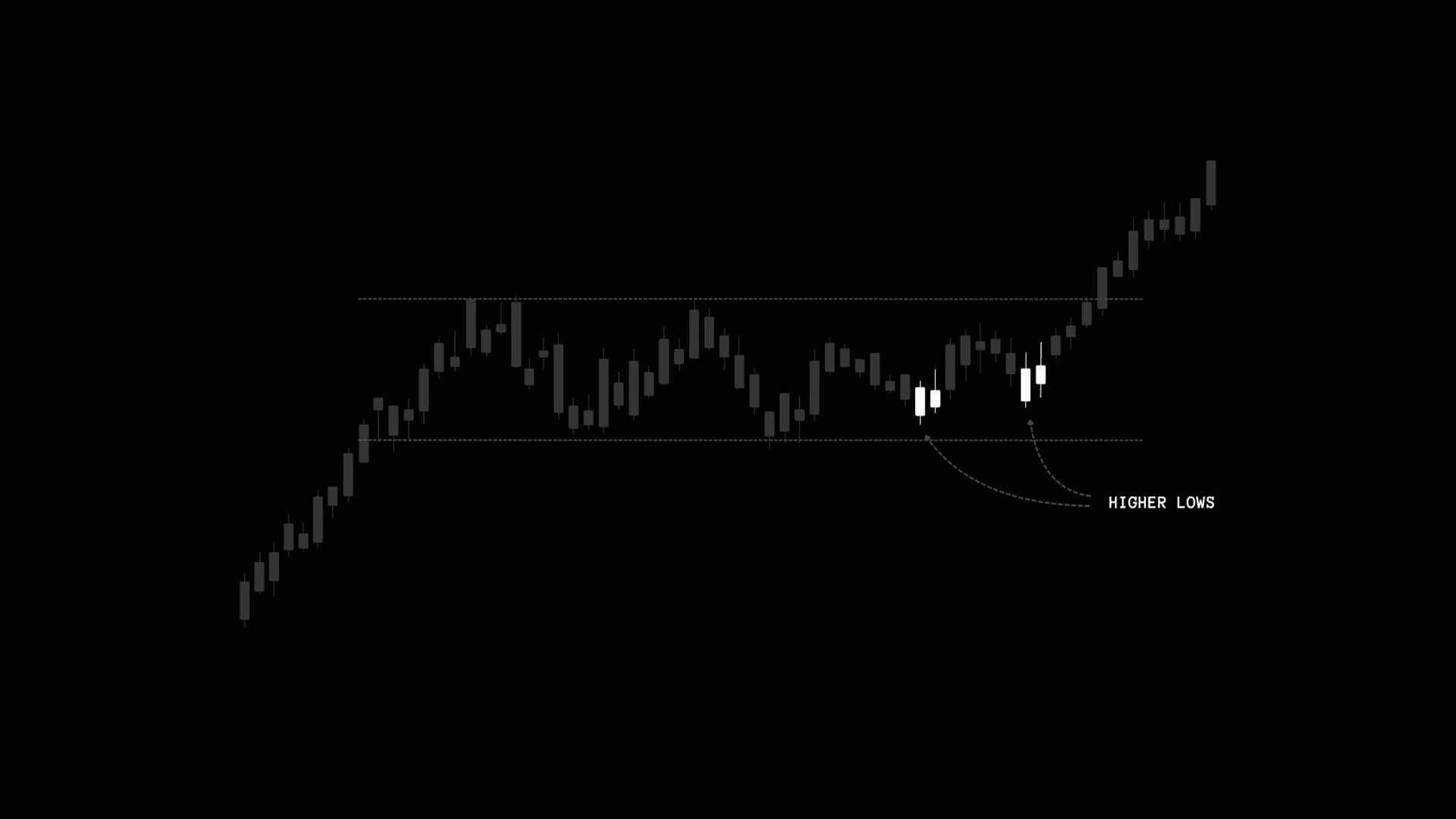
Base anatomy. The right side is what matters to me. I read higher lows as buyers stepping in earlier and drying volume as selling pressure easing. My preferred entry is where the stop can live right under the most recent higher low.
During those weeks and months, I think of ownership as changing hands, even though the chart cannot tell me exactly who is buying or selling. Some holders take profits, others move on, and new buyers may be willing to build inside the range without forcing price higher too fast.
Sideways alone is not enough. A base can still be early. It can be nowhere near ready. It can even be subtle distribution, where the chart looks fine but sellers are slowly winning. I care less about the range existing and more about how the range is changing. Mostly the lows, how controlled the action is, and whether the group is confirming.
The lows. Early in the bases I study, the stock often bounces between roughly the same ceiling and floor. As the right side improves, I want to see the lows creep up and each pullback tighten a little. I read those subtle higher lows as evidence that buyers are stepping in earlier and the base may be getting closer to a breakout.
Controlled action. I want the base to get tighter and lighter as it matures. I cannot know anyone's intent from the chart, so I treat smaller candles, quieter volume, and controlled pullbacks as evidence that supply may be getting absorbed and risk is becoming easier to define. Wide and loose action tells me the opposite: there is still too much disagreement for me to manage the trade tightly.
The group. I trust a base more when related names are also setting up or already working. If the stock looks good but nothing else in the group does, I trust it less. The group helps me judge whether the strength is broad enough to support what I see in one chart.
None of this guarantees the breakout. These are just the characteristics that tell me a base may be coming up the right side and getting closer to completion.
APP and SMCI
APP and SMCI are two examples I keep coming back to. Both had already made the prior move. Both spent months going sideways. Both started making higher lows on the right side before the breakout was obvious. That is the whole point for me: get involved when the chart is quieter and risk is easier to manage tightly, before the breakout draws more attention.
APP
APP · weekly
APP weekly chart showing a multi-month base with higher lows forming on the right side before a major breakout
SMCI
SMCI · weekly
SMCI weekly chart showing a multi-month base with higher lows forming on the right side before a major breakout
The sizing advantage
If I buy inside the base near a higher low, a weekly low, or a base pivot retest, sometimes the stop is only 2% or 3% away. Same stock, same general thesis, completely different position. The size comes from the entry, not from deciding to bet big.
If I wait for the breakout, the stop is usually wider. It might need to go back under the base, under the breakout pivot, or under the last real higher low. That means less size, even if I am right on the stock.
The cushion advantage
The other reason I like buying inside the base is cushion. If I buy the top of the base while attempting the breakout, it either works or I usually have to stop. There is not much room for a failed breakout, a shakeout, a reclaim, and then another attempt.
I assume breakouts draw more attention. In the examples I study, some never come back while others pull back, retest, or shake me out before they follow through. If I built the position earlier inside the base, I have cushion by the time the breakout happens.
Even 8% or 10% changes the trade for me. It is easier for me to sit through a retest, think clearly, and manage the trade instead of reacting to every candle. That does not mean I ignore the stop or let the trade turn into a mess. It just means I am not making decisions from the worst possible emotional spot.
What I want to see
- Prior leader, not random sideways chop.
- Right side improving: higher lows, tighter candles, quieter volume.
- Group is helping, or at least not fighting it.
- Entry comes on weakness or quiet action near a level, not strength at the top of the range.
- Initial stop is close enough to size, within 5%, ideally within 3%.
- Only add after the stock proves itself with another higher low, a push from the level, or a breakout/retest.
Related concepts
Character Change
Entry Tactics
My go-to setup for getting into possible new uptrends early, three pieces of evidence on the weekly chart that tell me the trend may have changed.

Wick Low
Entry Tactics
How I use the low of a candle's wick as a structural reference for stop placement and defining where my read is wrong.
Want to know when something new is published?